
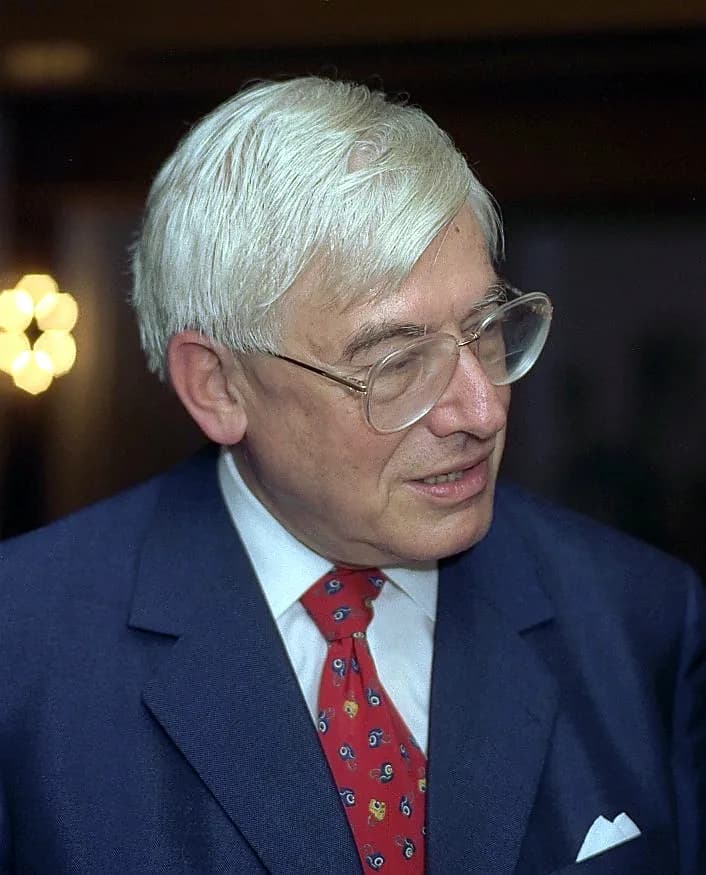
Memorial Page for Christian Schwarz-Schilling
German politician, entrepreneur and philanthropist
Memorial Candles
4 candles

“Ein großer Politiker und aufrechter Vermittler. Ruhe in Frieden.”
Matthias von Halem
June 5th, 2026

“Ihr Engagement bleibt unvergessen. Ruhen Sie sanft, Herr Minister.”
Renate Müller
June 5th, 2026

“RIF”
Markus
June 5th, 2026

Emoria lights a memorial candle in remembrance of Christian Schwarz-Schilling.
Emoria
April 6th, 2026
Condolence Book
0 Entries
Memories
21 memories

Freiburg im Breisgau: Eröffnung der internationalen Akademie-Wochen mit Bundespostminister Christian Schwarz-Schilling

Cara Schwarz-Schilling auf der re publica10 (4534712633)

Christian Schwarz-Schilling u Büdingenu, Njemačka, siječanj 2010.

KAS-Frankfurt M-Bild-22230-1

KAS-Schwarz-Schilling, Christian-Bild-5043-1

KAS-Schwarz-Schilling, Christian-Bild-2390-1

Christian-Schwarz-Schilling-2107

Bundesarchiv B 145 Bild-F082410-0012, Bremen, CDU-Bundesparteitag

Bundesarchiv B 145 Bild-F074268-0005, Dortmund, CDU-CSU Bundestagswahlkampf

Bundesarchiv B 145 Bild-F073619-0036, Mainz, CDU-Bundesparteitag, Schwarz-Schilling

Bundesarchiv B 145 Bild-F073619-0036, Mainz, CDU-Bundesparteitag, Schwarz-Schilling

Bundesarchiv B 145 Bild-F073619-0026, Mainz, CDU-Bundesparteitag, Schwarz-Schilling
Biography
Christian Schwarz-Schilling (born 19 November 1930 in Innsbruck; died 6 April 2026 in Büdingen) was a German CDU politician, entrepreneur and international mediator. He was a member of the German Bundestag from 1976 to 2002, served as Federal Minister for Posts and Telecommunications from 1982 to 1992 and in 2006/07 was High Representative for Bosnia and Herzegovina.

Background, studies and business
Schwarz-Schilling grew up in Berlin in a musical family. His father Reinhard Schwarz-Schilling was a composer, and his mother Dusza von Hakrid was a pianist. The Konrad Adenauer Foundation describes how he learned only late in life how much his mother's Jewish background was concealed during the Nazi period. After school he studied history and East Asian cultural and language studies in Berlin and Munich. He received his doctorate in 1956. He later took over the Accumulatorenfabrik Sonnenschein in Berlin and Büdingen with his future wife, Marie-Luise Jonen.
Hesse, Bundestag and CDU
Schwarz-Schilling joined the CDU in 1960. He became active in Hesse, served as a member of the state parliament, became general secretary of the Hessian CDU and later entered the Bundestag. Within the party he worked on education, economic and media policy. His business background shaped his views on competition, medium-sized enterprise and technological modernization. At the same time, the closeness of politics and business remained a point of public criticism, especially during his ministerial years.
Posts, telecommunications and media change
On 4 October 1982 Schwarz-Schilling became Federal Minister for Posts and Telecommunications. His years in office saw cable television, private broadcasting, mobile communications, digital switching technology and the first steps in reforming Deutsche Bundespost. He pursued a move away from state monopoly structures toward more competition. Some decisions, including cable and network policy of the time, later remained disputed; at the same time his tenure became a formative phase in German telecommunications history.
Resignation over Bosnia
On 14 December 1992 Schwarz-Schilling resigned from the federal cabinet. The reason was his protest against what he saw as Germany's too cautious response to the war in Bosnia and Herzegovina. The step visibly separated him from the line of the Kohl government. Afterward he worked for Bosnia and Herzegovina for years, first as an international mediator and later in further political and civil-society roles.

Bosnia and Herzegovina
On 31 January 2006 Schwarz-Schilling took office as High Representative for Bosnia and Herzegovina. He wanted to use the office's far-reaching intervention powers more cautiously and to place stronger emphasis on local political responsibility. This approach fitted his later role as mediator and public critic, but in a politically fragile country it was not without criticism. For Bosnia and Herzegovina he remained a public interlocutor after his term ended.
Farewell
Christian Schwarz-Schilling died in Büdingen, Hesse, on 6 April 2026 at the age of 95. The Bundestag commemorated him with a minute of silence on 16 April 2026. His career connected unusually many fields: entrepreneurship, CDU politics, media and telecommunications reform, and commitment to Bosnia and Herzegovina.
Life Events
5 EventsGeboren in Innsbruck
1930Christian Schwarz-Schilling wird in Innsbruck geboren.
Bundespostminister
1982Schwarz-Schilling wird Bundesminister für das Post- und Fernmeldewesen im Kabinett Helmut Kohl.
Rücktritt aus dem Bundeskabinett
1992Schwarz-Schilling tritt aus Protest gegen die deutsche Bosnien-Politik als Bundesminister zurück.
Amtsantritt in Bosnien und Herzegowina
2006Schwarz-Schilling übernimmt das Amt des Hohen Repräsentanten für Bosnien und Herzegowina.
Gestorben in Büdingen
2026Christian Schwarz-Schilling stirbt im Alter von 95 Jahren in Büdingen.
Obituary
No obituary yet
No obituary has been uploaded for this memorial page yet. If you are one of the loved ones and would like to upload one, you can register as the owner of this memorial page and add it afterward.
Family Tree
- Reinhard Schwarz-Schilling
- Cara Popescu
Christian Schwarz-Schilling. Forever remembered.