
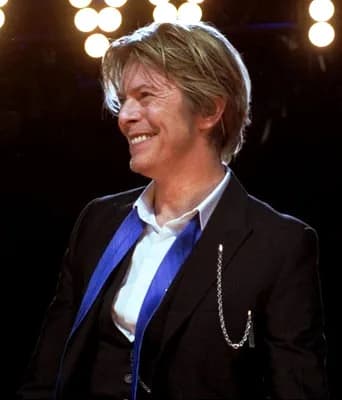
Memorial Page for David Bowie (née David Robert Jones)
English musician and actor
Memorial Candles
Condolence Book
0 Entries
Memories
20 memories

Ivan Kral and David Bowie laughing in Prague, Czechia 1996.

"Fashion" by David Bowie UK vinyl single

Berlin memorial plaque, David Bowie, Hauptstraße 155, Berlin-Schöneberg, Germany

Iman and David Bowie at the 2009 Tribeca Film Festival premiere of Moon.

David Bowie's star at the Hollywood Walk of Fame in 2007.

David Bowie in promotional photo for album Tonight, 1984.

David Bowie Let's Dance promo photo, 1983.

David Bowie, circa 1979 in a Lodger Promo photo.

David Bowie: The Return Of The Thin White Duke, full-page photo in Circus Magazine.

ON THE ROAD—British rock star, David Bowie, on first U.S. tour, performs at the Santa Monica Civic Auditorium

President Bill Clinton speaks with David Bowie and his band (cropped)

David Bowie (135687113) (cropped)
Biography
David Bowie (born David Robert Jones on 8 January 1947 in Brixton, London; died 10 January 2016) was an English singer, songwriter, musician and actor. Across a career spanning more than five decades he reinvented himself again and again: as the glam-rock alien Ziggy Stardust, as the well-dressed funk maestro the Thin White Duke, as the art rocker of the Berlin albums and as a hit-maker of the new-wave years. According to the BBC, some 140 million of his albums were sold after his first release in 1967. Berlin held a special place in his story: he lived there in the late 1970s, and in 1987 he performed right beside the Wall.

Childhood and first bands
His father, John, worked for the children’s charity Barnardo’s. In 1953 the family moved to Bromley in Kent, where David later went to Bromley Technical High School and studied art, music and design. His half-brother Terry Burns, nearly a decade older, introduced him to jazz musicians such as John Coltrane and Miles Davis, and in 1961 his mother bought him a plastic saxophone – an instrument that would become a recurring ingredient in his music.
In 1962, at fifteen, he formed his first band, the Konrads. Other outfits followed: Davie Jones with the King Bees, the Manish Boys, the Lower Third, the Buzz and the Riot Squad. To avoid confusion with Davy Jones of the Monkees, he adopted the name David Bowie. His first album, “David Bowie”, came out on Deram in June 1967. For a time he studied theatre and mime with the dancer Lindsay Kemp.
“Space Oddity” and “Hunky Dory”
In July 1969 Bowie released “Space Oddity”, the song that gave him his first commercial breakthrough: “Here am I sitting in a tin can, far above the world”. The BBC used it as the unofficial theme for the Apollo 11 mission, the single reached number five in the UK, and at the 1970 Ivor Novello Awards it earned him the Special Merit Award for Originality.
He married the art student Angela Barnett, and on 30 May 1971 their son Duncan was born, who would later become a film director. The same year saw the release of “Hunky Dory”, a mix of elaborate songwriting and infectious pop songs such as “Kooks”.

Ziggy Stardust
On 10 February 1972 the Ziggy Stardust tour officially began at the Toby Jug pub in Tolworth. With guitarist Mick Ronson, drummer Woody Woodmansey and bassist Trevor Bolder, Bowie formed the Spiders from Mars. “The Rise and Fall of Ziggy Stardust and the Spiders from Mars” (1972) changed everything: the single “Starman” brought the album instant success, and seeing Bowie perform as Ziggy on Top of the Pops was, in the Guardian’s words, a life-changing experience for a generation of British pop fans.
He helped others to success as well: his song “All the Young Dudes” gave Mott the Hoople a hit, and he co-produced Lou Reed’s album “Transformer” with Mick Ronson. “Aladdin Sane” (1973) became Bowie’s first UK number-one album. In July 1973 he shocked his audience at London’s Hammersmith Odeon by announcing the retirement of Ziggy Stardust. The covers album “Pin Ups” that followed also went to number one.
America, soul and the Thin White Duke
With the concept album “Diamond Dogs”, intended as a musical version of George Orwell’s “1984”, Bowie took an elaborately theatrical tour across the United States in 1974. His growing interest in funk and soul shaped “Young Americans” (1975), which he himself called “plastic soul”. With “Fame”, co-written with John Lennon, he topped the US chart for the first time on 20 September 1975, and he appeared on the television show Soul Train. In the autumn of 1975 a reissue of “Space Oddity” reached number one in the UK.
In Nicolas Roeg’s film “The Man Who Fell to Earth” he played the lead role of the melancholy space traveller Thomas Jerome Newton, and for the album “Station to Station” (1976) he carried that figure over into the Thin White Duke. At the same time, professional pressures and an escalating cocaine habit were taking their toll on him.

The Berlin years
In 1976 Bowie moved into a chalet in Blonay, near Montreux, with his family. By the end of that year he was living in West Berlin, where he had gone to kick drugs – accompanied by Iggy Pop, with whom he was working on Iggy’s album “The Idiot”, and by Brian Eno, who became the catalyst for his next musical leap. From 1976 to 1978 he lived in the same building as Iggy Pop, at Hauptstraße 155 in Schöneberg, where a Berlin memorial plaque has honoured him since 22 August 2016.
In July 1977 Bowie looked out of the window of Hansa Studios and saw a couple kissing by the Wall – the spark for the song “Heroes”. Years later he revealed that the lovers had been his producer Tony Visconti and a young German woman, Antonia Maass. He also recorded the song in German (“Helden”) and French (“Héros”). In 1978 he also took a leading role in the film “Just a Gigolo”.
Mixing krautrock influences with Brian Eno’s sound experiments, he created what became known as the Berlin Trilogy, which the composer Philip Glass later turned into three symphonies:
- Low (1977), with the single “Sound and Vision”, which reached number three in the UK.
- “Heroes” (1977), recorded at Hansa Studios, whose windows looked out on the Wall.
- Lodger (1979), recorded in Montreux and New York.

“Scary Monsters” and “Let’s Dance”
1980 was a year of creative triumph for Bowie: the album “Scary Monsters (and Super Creeps)” and the single “Ashes to Ashes” both reached number one in the UK, and from 23 September 1980 to 3 January 1981 he played John Merrick in “The Elephant Man” on Broadway, a well-received performance. That same year his marriage ended in divorce. In 1982 he bought the Château du Signal in the hills above Lausanne.
In 1981 he appeared in the German film “Christiane F.” and wrote music for its soundtrack, and he recorded “Under Pressure” with Queen, a UK number one. 1983 brought two films: “The Hunger”, alongside Catherine Deneuve, and Nagisa Ōshima’s Second World War drama “Merry Christmas, Mr. Lawrence”, with Ryuichi Sakamoto.
With “Let’s Dance” (1983), co-produced by Nile Rodgers, Bowie became a crowd-friendly global rock star; the album and its singles “Let’s Dance”, “China Girl” and “Modern Love” all became huge international hits. The title track, featuring guitarist Stevie Ray Vaughan, reached number one in both the UK and the US, and the six-month Serious Moonlight Tour drew massive crowds.

Great stages and a night by the Wall
On the album “Tonight” (1984) Bowie sang a duet with Tina Turner, and the short film “Jazzin’ for Blue Jean” won him a Grammy. In 1985 he was one of the standout performers at the Live Aid famine relief concert at London’s Wembley Stadium, and with Mick Jagger he recorded the fundraising single “Dancing in the Street”, which went to number one. In 1986 he played Jareth the Goblin King in Jim Henson’s fantasy film “Labyrinth” and wrote five songs for it.
In early June 1987, over the Whitsun weekend, the West Berlin Senate staged the “Concert for Berlin” in front of the Reichstag, with Bowie among the stars alongside Genesis and Eurythmics. The concert was deliberately held right beside the Wall, with many loudspeakers pointing east. Hundreds of young East Berliners gathered on Unter den Linden to listen at least. From day to day more people came on the eastern side; the Stasi and the People’s Police were overwhelmed, and some young people and journalists were beaten with batons. When Bowie died in 2016, the German Foreign Office thanked him for helping to bring down the Wall.
In 1988 he played Pontius Pilate in Martin Scorsese’s “The Last Temptation of Christ”. He then formed the band Tin Machine with guitarist Reeves Gabrels and Tony and Hunt Sales, in which he wanted to appear as a band member rather than a solo star.
A new beginning in New York
A few days after performing at the Freddie Mercury Tribute Concert at Wembley Stadium, Bowie married the Somali model Iman in Lausanne in April 1992, eighteen months after they had met; the couple bought a home in New York. “Black Tie White Noise” reached number one in the UK in 1993. With Brian Eno he made “Outside” (1995), another commercial success, and “Earthling” (1997) borrowed elements of drum and bass. In 1996 he was inducted into the Rock and Roll Hall of Fame.
He celebrated his 50th birthday on 9 January 1997 with a sold-out concert at Madison Square Garden in New York, joined by guests including Lou Reed, Robert Smith, Sonic Youth and the Foo Fighters. The same year he launched the “Bowie Bonds”, netting 55 million dollars upfront, and in September 1998 his own internet service, BowieNet, went live.

Family and later years
In August 2000 his daughter Alexandria was born. Bowie declined appointment as a Commander of the Order of the British Empire, and in 2003 he also turned down a knighthood. For the albums “Heathen” and “Reality” he worked with Tony Visconti again. According to Billboard, the North American leg of the A Reality Tour was the top-grossing tour of the first half of 2004.
On 25 June 2004 he performed at the Hurricane Festival in Scheeßel, Germany. He suffered chest pains during the show; a blocked artery was cleared in an emergency procedure in Hamburg, and the rest of the tour was cancelled. In 2006 he announced a break from touring and recording. That same year he sang “Changes” as a duet with Alicia Keys at the Black Ball charity gala in New York – his last public performance as a musician. In Christopher Nolan’s film “The Prestige” (2006) he played the inventor Nikola Tesla, and in February 2006 he received the Grammy Lifetime Achievement Award.
“The Next Day” and “Blackstar”
In 2013 Bowie returned with “The Next Day”, his first album of new material in a decade; it became his first number-one album in Germany. In 2014 the Victoria and Albert Museum’s exhibition “David Bowie is” was shown at the Martin-Gropius-Bau in Berlin. That year he was named British Male Solo Artist and became the oldest winner of a Brit Award; Kate Moss accepted the prize on his behalf.
He kept secret the cancer he fought for eighteen months. From January 2015 he recorded his final album at the Magic Shop studio in New York with Donny McCaslin’s band, and on 7 December 2015 he took a bow on stage at New York Theatre Workshop after the premiere of “Lazarus”, the musical built around his songs. “Blackstar” was released on 8 January 2016, his 69th birthday. Two days later David Bowie died, surrounded by his family.
Tony Visconti wrote: “He made Blackstar for us, his parting gift.” In accordance with his will, there was no funeral; he was cremated in New Jersey on 12 January. He had asked for his ashes to be scattered in Bali in accordance with Buddhist rituals. “Blackstar” went to number one in the UK and in Germany and became his first number-one album in the United States.
Legacy
The BBC’s arts editor, Will Gompertz, called him “the Picasso of pop”: an innovative, visionary, restless artist who, along with the Beatles, the Stones and Elvis Presley, defined what pop music could and should be. In 2005 Bowie was inducted into the Songwriters Hall of Fame. After his death, “Blackstar” won all five Grammy Awards for which it had been nominated in 2017, and at the 2017 Brit Awards he was named British Male Solo Artist and won British Album of the Year.
In Brixton, hundreds of fans laid flowers and candles at his mural and sang his songs; crowds also gathered outside his home in New York and in Berlin. Deutsche Post issued a special stamp for his 75th birthday on 3 January 2022, and the Frankfurt arachnologist Peter Jäger of the Senckenberg Research Institute named a new genus of wandering spiders after him in 2022. On 13 September 2025 the David Bowie Centre, home to his archive, opened at the V&A East Storehouse in London. According to Official Charts Company data, in 2022 he was the UK’s best-selling vinyl artist of the 21st century.
Life Events
14 EventsGeboren in Brixton
1947David Robert Jones kommt im Londoner Stadtteil Brixton zur Welt.
Sohn Duncan kommt zur Welt
1971Duncan Jones, später Filmregisseur, ist Bowies Sohn aus der Ehe mit Angela Barnett.
Beginn der Ziggy-Stardust-Tournee
1972Im Pub Toby Jug in Tolworth beginnt offiziell Bowies Ziggy-Stardust-Tournee.
Letztes Ziggy-Konzert
1973Im Londoner Hammersmith Odeon spielen Ziggy Stardust and the Spiders from Mars ihr letztes Konzert.
„Fame“ auf Platz eins in den USA
1975Mit „Fame“, gemeinsam mit John Lennon geschrieben, steht Bowie erstmals an der Spitze der Billboard Hot 100.
„The Elephant Man“ am Broadway
1980Im Booth Theatre in New York beginnt Bowies Spielzeit als John Merrick.
Heirat mit Iman
1992David Bowie und Iman heiraten in Lausanne.
Konzert zum 50. Geburtstag
1997Ausverkauftes Konzert im Madison Square Garden, unter anderem mit Lou Reed, Robert Smith und den Foo Fighters.
Letzter Tourauftritt in Scheeßel
2004Beim Hurricane Festival gibt Bowie sein letztes Tourkonzert; die restlichen Termine werden abgesagt.
Premiere von „Lazarus“
2015Nach der Premiere des Musicals mit seinen Liedern verbeugt sich Bowie im New York Theatre Workshop auf der Bühne.
„Blackstar“ erscheint
2016An seinem 69. Geburtstag erscheint Bowies letztes Album.
Tod mit 69 Jahren
2016David Bowie stirbt zwei Tage nach seinem 69. Geburtstag im Kreis seiner Familie.
Berliner Gedenktafel enthüllt
2016Am Haus Hauptstraße 155 in Schöneberg, wo Bowie von 1976 bis 1978 wohnte, wird eine Berliner Gedenktafel enthüllt.
David Bowie Centre öffnet
2025Im Londoner V&A East Storehouse öffnet das David Bowie Centre mit seinem Archiv.
Obituary
No obituary yet
No obituary has been uploaded for this memorial page yet. If you are one of the loved ones and would like to upload one, you can register as the owner of this memorial page and add it afterward.
David Bowie (née David Robert Jones). Forever remembered.