Memorial Page for Mario Adorf (née Mario Matteo Adorf)
German actor
Memorial Candles
7 candles

“Vielen Dank Mario …..Du warst großartig!❤️🐬”
Rosel Wolter
September 11th, 2026

Emoria lights a memorial candle for Mario Adorf's birthday.
Emoria
September 8th, 2026

“Ein großer Schauspieler ist gegangen. Mein Beileid den Angehörigen.”
Klaus Mertens
June 5th, 2026

“Ihre Geschichten und Filme werden bleiben!”
Andreas F.
June 5th, 2026

“Eine Stimme und Präsenz, die man nie vergisst. Mein aufrichtiges Beileid.”
Helmut Franke
June 5th, 2026

“eine absolute legende. danke für die vielen tollen filme”
Jens W.
June 5th, 2026
Emoria lights a memorial candle in remembrance of Mario Adorf.
Emoria
April 8th, 2026
Condolence Book
0 Entries
Memories
18 memories
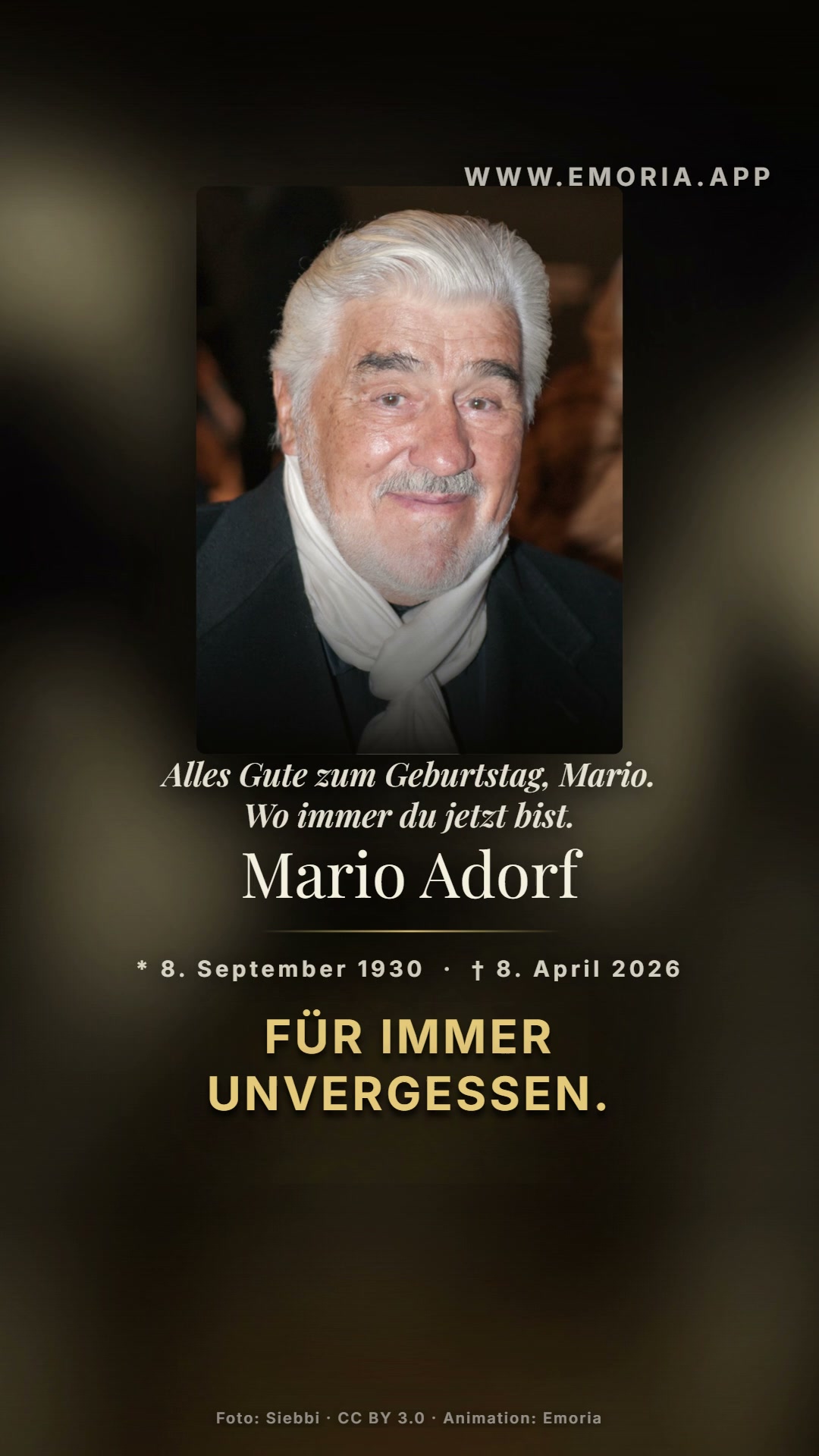
🎂 Birthday

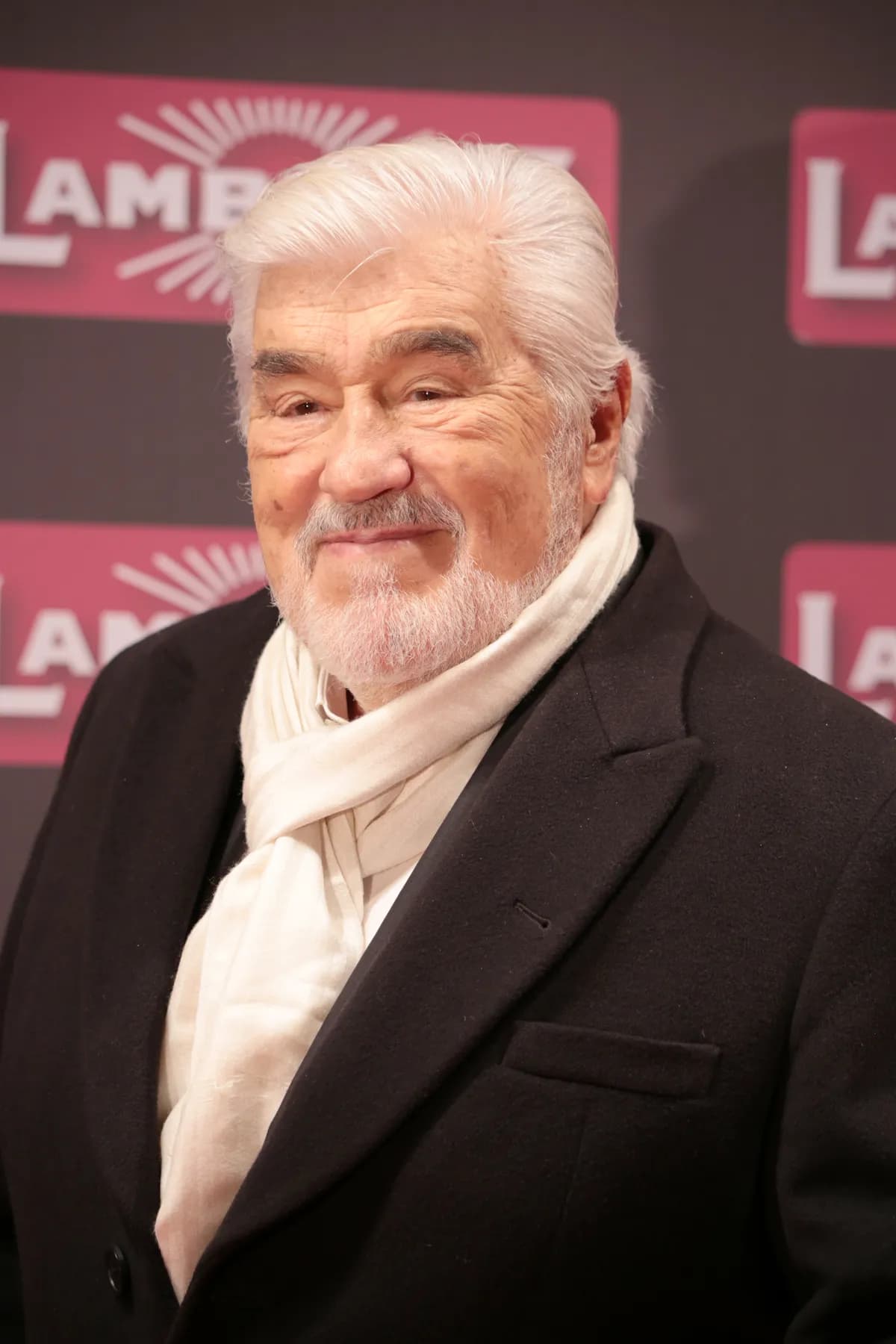
Der Schauspieler Mario Adorf im Oktober 2005 in München. Titel des Werks: "Mario Adorf (2005)"

Mario Adorf at Berlin and Beyond Film Festival, San Francisco (2012)

Der Schauspieler Mario Adorf im Oktober 2005 in München.Titel des Werks: "Mario Adorf (2005)"

This file was uploaded with Commonist.

Franzen-adorf

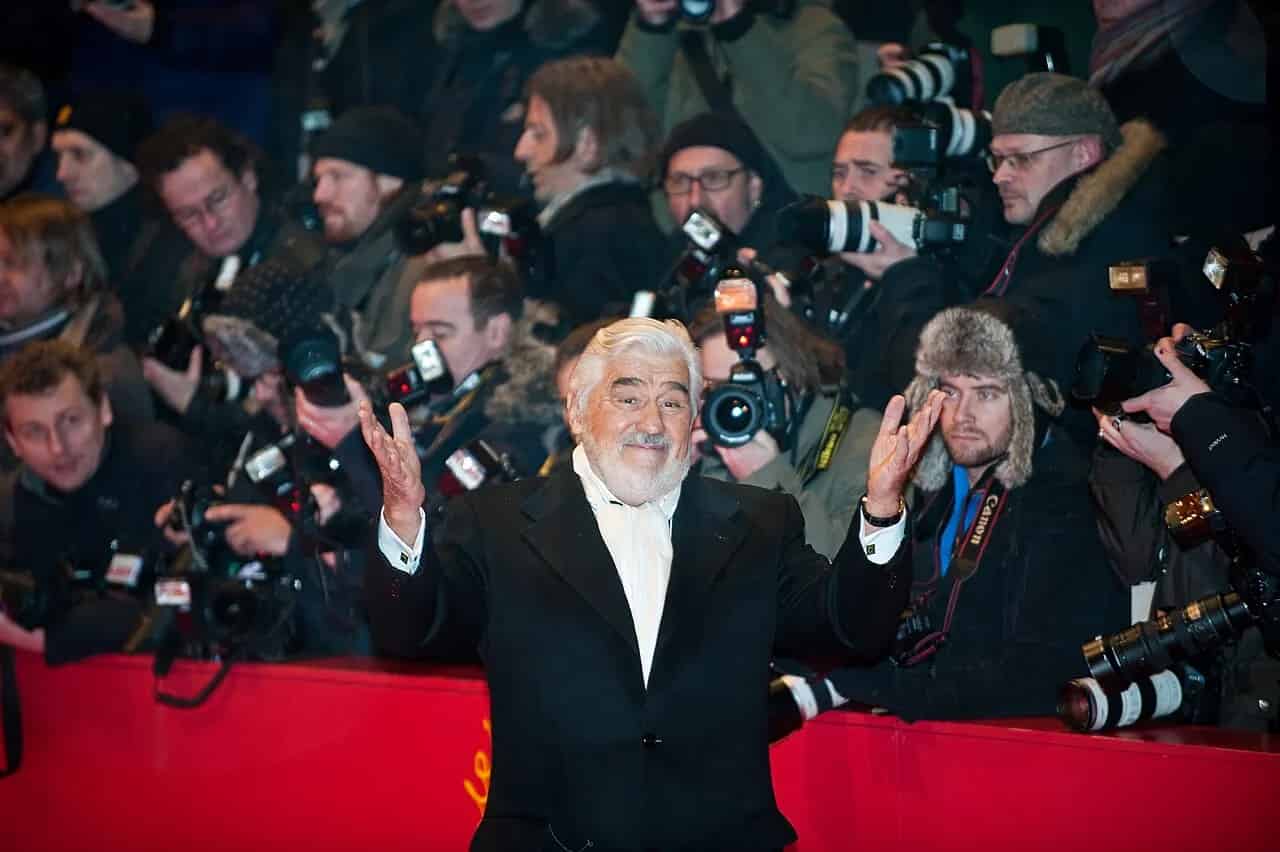
German actor Mario Adorf arriving at the premiere of True Grit at the Berlin Film Festival 2011

German actor Mario Adorf leaving the premiere of True Grit at the Berlin Film Festival 2011

Star of Mario Adorf at "Boulevard der Stars" in Berlin.

Mario Adorf. Gemälde auf einer Hauswand in Mayen

"Mayener Jung". Nach einem Entwurf von Mario Adorf

Bundesarchiv B 145 Bild-F034157-0025, Bonn, Bundeskanzler Brandt empfängt Schauspieler

Bundesarchiv B 145 Bild-F034157-0018, Bonn, Bundeskanzler Brandt empfängt Schauspieler
Biography
Mario Adorf (born 8 September 1930 in Zurich; died 8 April 2026 in Paris) was one of the best-known actors of German-language cinema. His work spans around 220 film and television productions between 1954 and 2023, alongside decades on stage, radio plays, audiobooks and several books of his own. He could play the roughneck, the crook, the Italian gentleman, the patriarch. What held his characters together was not their hardness but what lay beneath it: wit, vulnerability, and a physical presence that carried a scene even when he said nothing.

A child of Zurich, a boy from Mayen
Mario Adorf was born in Zurich, his mother's birthplace. Alice Adorf (1905 to 1998) had worked as a radiographer at a clinic in Siderno in southern Italy, run by the surgeon Matteo Menniti. She was expecting his child, and heavily pregnant she fled from Italy to Switzerland so that the baby would not be taken into state care. Three months after the birth she returned to Germany and moved to Mayen in the Eifel region, where her own father came from and where she had lived as a child. Adorf did not meet his father until he was 21.
In Mayen his mother worked as a seamstress and dressmaker. When her son was three she placed him in the town's children's home run by the Sisters of Saint Charles Borromeo, because she had neither the money nor the space to keep him. The home closed at the start of the Second World War and he returned to her. He attended the sisters' kindergarten, the local primary school and the municipal grammar school. He was a member of the Hitler Youth, took part in a paramilitary training course at Hermeskeil in 1944 and was drafted into the Volkssturm in early 1945, at the age of fourteen.
Boxing team and student stage
After finishing school, Adorf studied humanities at the University of Mainz from 1950: philosophy, psychology, criminology, literature, musicology and theatre studies. To pay for his studies he worked as a steel fixer on the construction of a new Schott AG plant. In his free time he boxed for a student team and performed on a student stage, where he gathered his first acting experience.
In 1953 he moved to Zurich, worked at the Schauspielhaus as an extra and assistant director, abandoned his degree and trained as an actor at the Otto Falckenberg School in Munich from 1953 to 1956. From 1954 he appeared at the Munich Kammerspiele, holding a permanent engagement there from 1955 to 1962. Those theatre years stayed audible in his screen work: Adorf could play big, but he could just as easily hold a scene with posture, voice and a look.
Bruno Lüdke and the breakthrough
The breakthrough came the year after his training ended. In Robert Siodmak's crime film The Devil Strikes at Night (1957) Adorf played Bruno Lüdke, a man whom the Nazi authorities had falsely declared a serial killer. The role brought him to a wide cinema audience and won him the German Film Award in gold as best newcomer and the German Film Critics' Award as best actor in 1958.
He never grew comfortable with that success. Looking back, Adorf criticised the fact that a scene he considered central had been cut from the film, a scene that would have confronted the character's crimes with the Nazi extermination programme. His other early work included the pimp in Rosemary (1958) and the chess world champion Czentovic in The Royal Game (1960).
Santer, the role of a lifetime
For years Adorf was typecast as a villain, and no part followed him like this one: in Winnetou the Warrior (1963) he played Santer, the antagonist who shoots Winnetou's sister Nscho-tschi. Half a century later, in 2013, he described how often strangers brought it up:
Again and again I meet people who say: "The fact that you shot Nscho-tschi, I did not forgive you that for many years. I hated you for it!" That is a sentence I have heard tens of thousands of times.
He took it with humour, and in the end he even returned to that world: in 2016 he played the father of that same Santer in the three-part television film Winnetou – Der Mythos lebt. In the crime comedy Die Herren mit der weißen Weste (1970) he played the crook Bruno "Dandy" Stiegler, and in Roland Klick's neo-western Deadlock (1970) a hermit.
Rome, his adopted home
Adorf worked in Italian cinema for decades and lived in Rome for many years. Asked what he valued about the city, he answered in the documentary Es hätte schlimmer kommen können, looking back at the 1960s:
My past. Back then it was of course that dolce vita period, in terms of living a very easy life, where you could live very well, even on little money. A very good-humoured time as well.
He appeared in numerous Italian productions, among them the drama Il delitto Matteotti (1973), in which he played Mussolini. For Fernando Di Leo he played Rocco Musco in Caliber 9 (1972). Internationally he worked with Sam Peckinpah (Major Dundee, 1965, as Sergeant Gomez), Billy Wilder (Fedora, 1978), Claude Chabrol (Quiet Days in Clichy, 1990) and Bille August (Smilla's Sense of Snow, 1997).

Katharina Blum, The Tin Drum, Lola
From the mid-1970s the directors of the New German Cinema brought him in, and Adorf was given parts that had nothing to do with the villain trade. For Volker Schlöndorff and Margarethe von Trotta he played the shady police inspector in The Lost Honour of Katharina Blum (1975), adapted from Heinrich Böll, opposite Angela Winkler. In 1979 he was Alfred Matzerath in Schlöndorff's The Tin Drum, after Günter Grass, alongside David Bennent and Katharina Thalbach; the film won the 1980 Academy Award for best foreign language film. He appeared in the portmanteau film Germany in Autumn (1978), played the property developer Schuckert in Rainer Werner Fassbinder's Lola (1981) opposite Barbara Sukowa, and the mason Nicola in Momo (1986), after Michael Ende.
One of his parts was never seen by a cinema audience: in 1981 Adorf played the ship's captain in a first shooting block of Werner Herzog's Fitzcarraldo, alongside Jason Robards and Mick Jagger. That version was never finished and never released as a film.
Haffenloher and the patriarchs
In 1986 Adorf appeared in a single episode of Helmut Dietl's satirical series Kir Royal as Heinrich Haffenloher, a manufacturer determined to buy his way into the gossip column at any price. His line to the reporter Baby Schimmerlos became one of the best-known sentences in German television:
Ich scheiß dich zu mit meinem Geld. (I'll bury you in my money.)
Out of that supporting part grew the figure that defined his later work: the patriarch. Dieter Wedel cast him in several miniseries watched by millions, as Peter Bellheim in Der große Bellheim (ZDF, January 1993), in Der Schattenmann (1996) and in Die Affäre Semmeling (2002). In 1997 he played the owner of a Munich society restaurant in Dietl's Rossini, which drew 3.2 million cinema-goers and was one of the most successful German films of that year.
From December 1996 he took the title role in the Sat.1 crime series Tresko, an art expert whose character he had developed together with the writer Peter Zingler. He ended the series in early 1997 in order to care for his ailing mother. Alice Adorf died in 1998.
The storyteller
Adorf wrote, and he kept at it for more than two decades. Der Mäusetöter appeared in 1992, followed by Der Dieb von Trastevere (1994), Der Fenstersturz (1996), Der römische Schneeball (2000), Der Fotograf von San Marco (2003) and the memoir Himmel und Erde (2004). In 2005 he published Mit einer Nadel bloß, a book about the mother who had raised him under difficult circumstances. Schauen Sie mal böse, stories from his life as an actor, followed in 2015.
His voice was a body of work in itself. He recorded radio plays from Ingeborg Bachmann to Aeschylus, read Joseph Roth, Stefan Zweig, Maupassant and Goethe, sang songs by Georg Kreisler on the 1996 album Schön bös, and in the same year gave the German voice to the dragon Draco in Dragonheart. His final recording appeared in 2023: Adorf liest Stefan Zweig.

Mayen, Worms, Mainz
The town of his childhood never let go of him, nor he of it. In 2001 Mayen made him an honorary citizen, and in 2014 it named a lane after him. He waves from a painted window on a house wall there, and beneath the Genoveva castle a basalt figure kneels, the "Mayener Jung", made to a design by Adorf. In 2010 the Johannes Gutenberg University of Mainz, where he had once studied, awarded him an honorary doctorate.
He was one of the founders of the Nibelungen Festival in Worms and appeared on its stage himself in 2002 and 2003. Since 2018 the city of Worms and the festival have awarded the Mario Adorf Prize to artists working at the festival.

Honours
- 1958 German Film Award in gold as best newcomer and German Film Critics' Award for The Devil Strikes at Night
- 1974 Ernst Lubitsch Award · 1978 Bambi as most popular actor of the year
- 1982 German Film Award in silver for Lola · 1992 German Film Award in gold for Pizza Colonia
- 1994 Adolf Grimme Award and Golden Camera for Der große Bellheim
- 1993 Federal Cross of Merit, 2001 Grand Cross of Merit
- 1996 Carl Zuckmayer Medal · 2000 Bavarian Film Award for lifetime achievement · 2003 Bavarian Order of Merit · 2005 Order of Merit of Rhineland-Palatinate
- 2001 Honorary citizen of Mayen · 2010 Honorary doctorate, University of Mainz
- 2004 German Film Award, LOLA in gold as an honorary award for outstanding services to German cinema
- 2010 Star on the Boulevard der Stars in Berlin · 2012 Golden Camera for lifetime achievement
- 2016 Pardo alla carriera at the Locarno Film Festival and Bambi for lifetime achievement · 2022 European Culture Award · 2024 German Television Award, honorary prize

Later years
In 2003 Adorf was a founding member of the German Film Academy, and in 2007 he served on the Berlinale jury chaired by Paul Schrader. In 2010, for his 80th birthday, he starred in the two-part ARD drama Der letzte Patriarch as the marzipan manufacturer Konrad Hansen, shot in Hamburg, Lübeck, Shanghai and Singapore alongside Hannelore Elsner and Ursula Karven. Of the character he said:
Hansen is a charming so-and-so who can be pretty hard. But he recognises his mistakes and learns from them. That is what made the part so interesting for me.
That same year he named his greatest wish: to play Karl Marx once. In 2018 he did, in the ZDF docudrama Karl Marx – der deutsche Prophet. From 2009 he served as an ambassador for good hearing, working against the stigma attached to hearing loss. In 2012 the Academy of Arts in Berlin, which holds his archive, presented the exhibition Mario Adorf. …böse kann ich auch. In 2019 Dominik Wessely's cinema documentary Es hätte schlimmer kommen können was released.

Family
Adorf was first married to the actress Lis Verhoeven (1931 to 2019); their daughter Stella Maria Adorf, born in 1963, is also an actress. He met Monique Faye in 1968, introduced by her friend Brigitte Bardot; they married in 1985 and remained together until his death. He lived in Campione d'Italia, and later in Munich, Paris and Saint-Tropez.

Farewell
Mario Adorf died on Wednesday 8 April 2026 at his Paris apartment, aged 95. His long-time manager Michael Stark announced it the following day: Adorf had "fallen asleep after a short illness in his apartment in Paris". On a last visit shortly before, Stark said, Adorf had given him something to pass on: his thanks to his audience for decades of loyalty.
Mayen opened a book of condolence at the town hall and held an ecumenical service in the Clemenskirche on 17 April, with the municipal orchestra and the standard-bearers of the town's associations. On 2 May some 200 invited guests gathered at the Jesuit church of St Michael in Munich, among them his wife and his daughter, Senta Berger, Uschi Glas, Iris Berben, Veronica Ferres and Günter Netzer. Iris Berben opened her eulogy with "Ach, liebster Mario" and said:
To me you were always an accomplice in art, an accomplice in life.
His publisher Helge Malchow read out a short story Adorf had written shortly before his death, and his manager read lines from those same last weeks: only when the moment comes, Adorf had written, do we notice that we have thought ourselves immortal all our lives. He wanted to accept the end without complaining.
What endures
Asked about his identity, Adorf once said he felt like "half an Italian". He had always been drawn south, he said, and later noticed that everything that interested him about Italy, above all its art, interested him from a German sensibility. In his final years he spoke more often again about the Eifel and the Rhenish dialect of his childhood.
After his death the minister-president of Rhineland-Palatinate, Alexander Schweitzer, called him an "exceptional actor and a world star who always remained closely attached to his home town of Mayen and to the state of Rhineland-Palatinate".
His work runs from post-war cinema through spaghetti westerns and the New German Cinema to the great television miniseries, along with the stage, his books and his recordings. He never played his villains smooth, and never played his patriarchs merely loud. He gave them weight, contradiction and humour, and something of himself went into them too: the boy from the children's home in Mayen, the son of a seamstress and a surgeon, who remained both German and Italian all his life and never quite settled into any single role.
Life Events
21 EventsGeboren in Zürich
1930Mario Adorf kommt in Zürich zur Welt, dem Geburtsort seiner Mutter Alice Adorf.
Studium in Mainz
1950Adorf studiert Geisteswissenschaften an der Universität Mainz und steht erstmals auf einer Studentenbühne.
Otto-Falckenberg-Schule
1953Bis 1956 absolviert Adorf in München seine Schauspielausbildung.
Erste Filmrolle in 08/15
1954Adorf steht erstmals für einen Kinofilm vor der Kamera und tritt an den Münchner Kammerspielen auf.
Festes Engagement an den Kammerspielen
1955Bis 1962 gehört Adorf fest zum Ensemble der Münchner Kammerspiele.
Nachts, wenn der Teufel kam
1957Als Bruno Lüdke in Robert Siodmaks Kriminalfilm wird Adorf einem großen Kinopublikum bekannt.
Filmband in Gold
1958Adorf erhält den Bundesfilmpreis als bester Nachwuchsschauspieler und den Preis der deutschen Filmkritik.
Santer in Winnetou 1. Teil
1963Die Rolle des Gegenspielers Santer begleitet Adorf ein Leben lang.
Die verlorene Ehre der Katharina Blum
1975Bei Volker Schlöndorff und Margarethe von Trotta spielt Adorf den zwielichtigen Kommissar.
Die Blechtrommel
1979Als Vater Matzerath steht Adorf in Schlöndorffs Verfilmung des Romans von Günter Grass vor der Kamera.
Lola
1981Bei Rainer Werner Fassbinder spielt Adorf den Baulöwen Schuckert.
Heirat mit Monique Faye
1985Adorf heiratet Monique Faye, die er 1968 durch ihre Freundin Brigitte Bardot kennengelernt hatte.
Haffenloher in Kir Royal
1986Eine einzige Folge von Helmut Dietls Serie macht Adorfs Generaldirektor Haffenloher unvergesslich.
Der große Bellheim
1993Dieter Wedels Mehrteiler mit Adorf als Peter Bellheim erreicht ein Millionenpublikum.
Rossini
1997Helmut Dietls Komödie mit Adorf erreicht 3,2 Millionen Kinobesucher.
Ehrenbürger von Mayen
2001Die Stadt seiner Kindheit ernennt Adorf zum Ehrenbürger.
Ehrenpreis des Deutschen Filmpreises
2004Adorf wird für herausragende Verdienste um den deutschen Film ausgezeichnet.
Stern auf dem Boulevard der Stars
2010In Berlin wird ein Stern für Adorf verlegt; im selben Jahr ehrt ihn die Universität Mainz mit der Ehrendoktorwürde.
Karl Marx
2018Adorf erfüllt sich einen langgehegten Wunsch und spielt Karl Marx im ZDF-Doku-Drama.
Deutscher Fernsehpreis
2024Adorf erhält den Ehrenpreis für sein Lebenswerk.
Verstorben in Paris
2026Mario Adorf stirbt im Alter von 95 Jahren in seiner Pariser Wohnung.
Obituary
No obituary yet
No obituary has been uploaded for this memorial page yet. If you are one of the loved ones and would like to upload one, you can register as the owner of this memorial page and add it afterward.
Family Tree
- Lis Verhoeven
Mario Adorf (née Mario Matteo Adorf). Forever remembered.