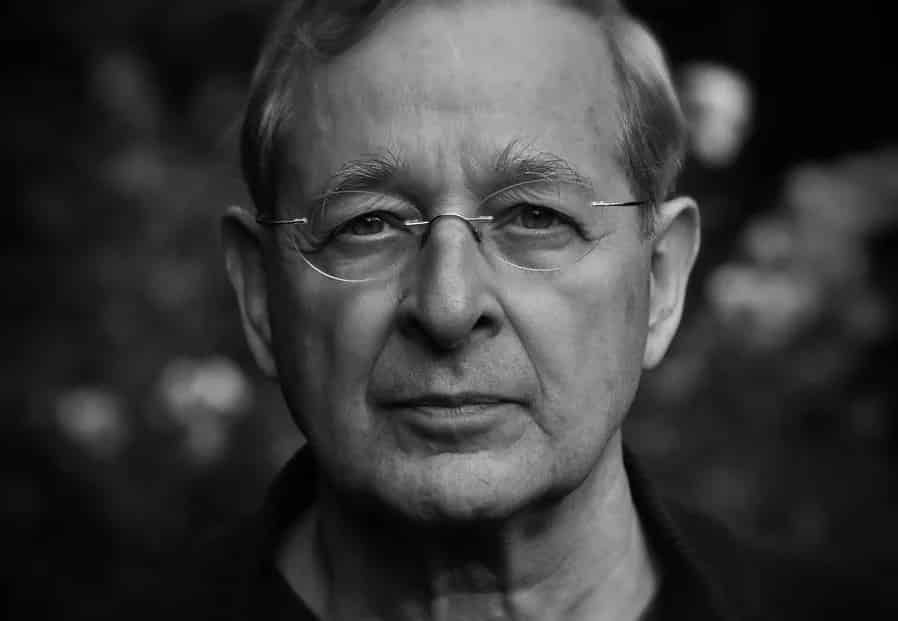
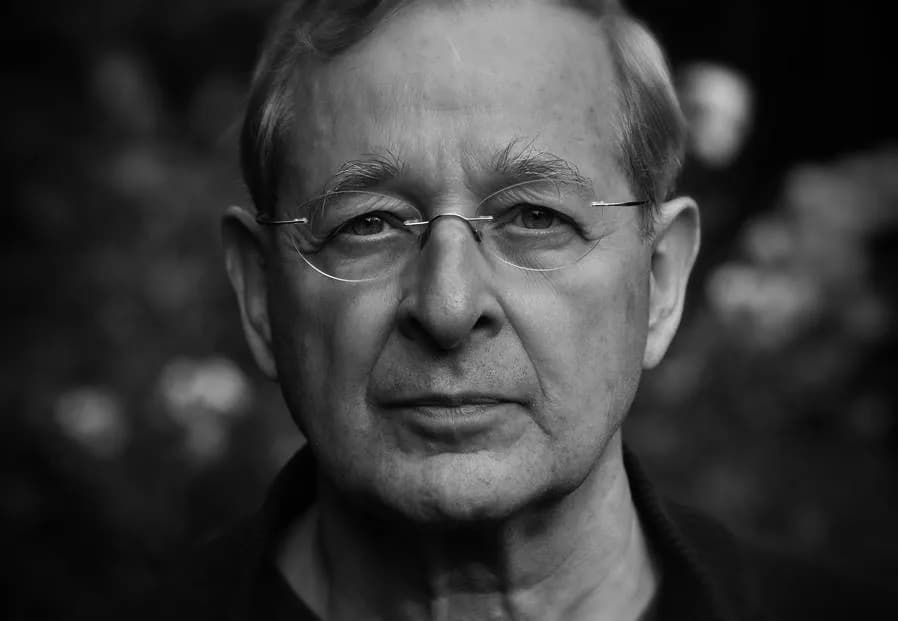
Memorial Page for Péter Nádas
Hungarian writer and photographer
Memorial Candles
1 candle

Emoria lights a memorial candle for Péter Nádas's birthday.
Emoria
October 14th, 2026
Condolence Book
0 Entries
Memories
8 memories
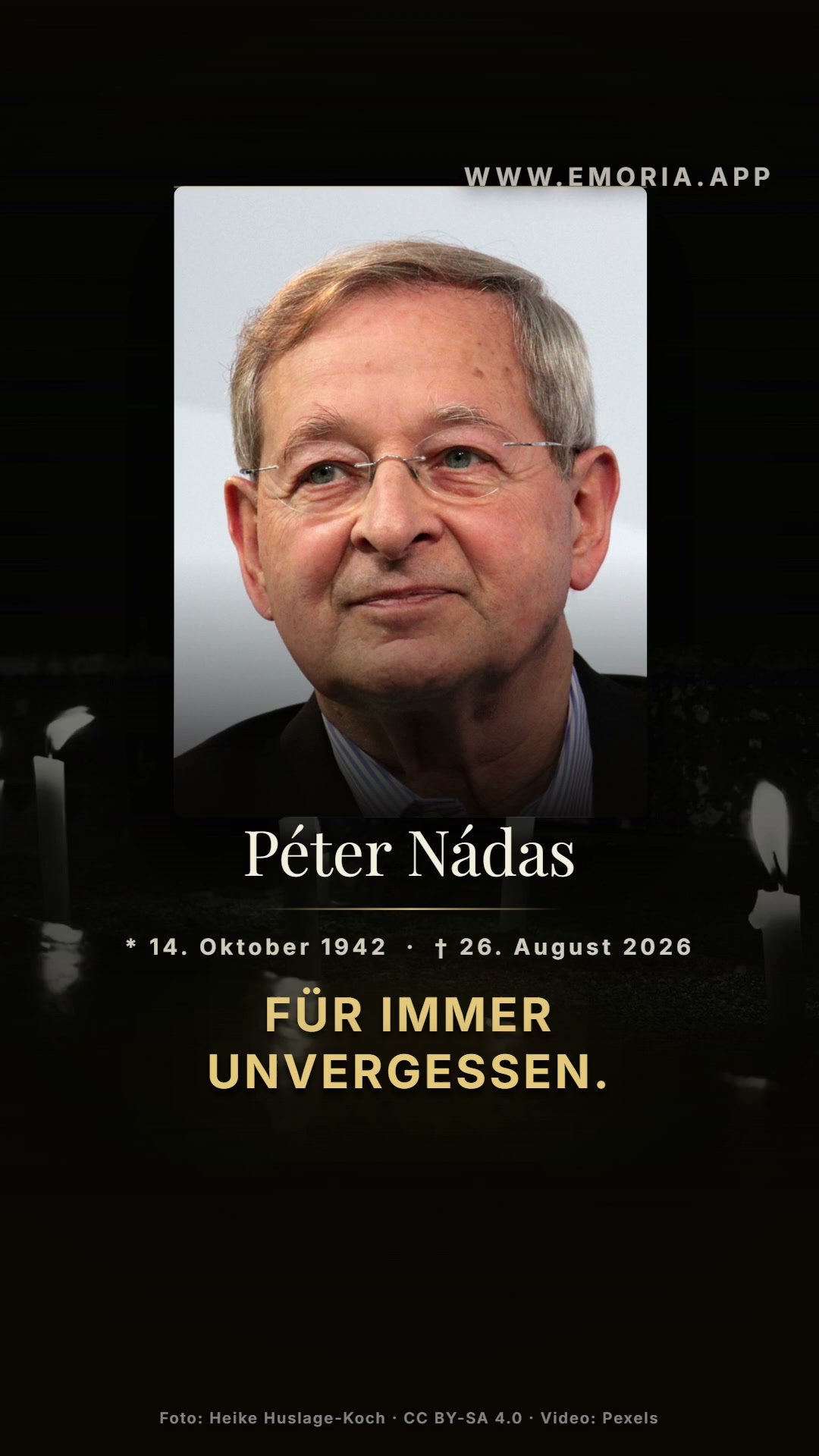
Péter Nádas

Péter Nádas auf der Frankfurter Buchmesse, 12. Oktober 2017

Péter Nádas beim Festivaletteratura in Mantua, 6. September 2012

Péter Nádas auf der Leipziger Buchmesse, 15. März 2012

Péter Nádas auf der Buchmesse Göteborg, 24. September 2011

Péter Nádas, fotografiert von Bahget Iskander, 24. April 2007

»Emlékiratok könyve« (Buch der Erinnerung) — Umschlag der Erstausgabe von 1986

Péter Nádas 1984 — Autorenfoto aus der Anthologie »Körkép 1984«

Péter Nádas — Porträt des Fotografen Gáspár Stekovics
Biography
Péter Nádas (born 14 October 1942 in Budapest; died 26 August 2026 in Gombosszeg) was a Hungarian writer and photographer. With A Book of Memories and Parallel Stories he wrote two of the great European novels of his time. Few Hungarian authors were read as closely, or honoured as highly, in the German-speaking world — most recently with the Grand Cross of Merit with Star, presented to him in Berlin barely three months before his death.
A child with false papers
Péter Nádas was born in Budapest on 14 October 1942, the son of Klára Tauber, a worker, and László Nádas, a telephone technician. The family was Jewish; the ancestors of his maternal grandfather Arnold Tauber had been Moravian rabbis for more than ten generations. Because his parents lived underground during the Holocaust, a false name was entered on his birth certificate.
After the Arrow Cross seized power on 15 October 1944, his mother fled with the two-year-old on forged papers to the Bačka region and on to Novi Sad; they returned to Budapest immediately before the siege. His father walled himself into a cellar on the Újpest embankment together with his siblings and a friend, forging papers and printing leaflets. Péter Nádas survived the siege with his mother in the flat of his uncle, the journalist Pál Aranyossi, among other children and adults brought there on forged papers. The building was hit by a bomb.
Two losses
In 1953 his father, by then a department head at the Ministry of Posts, was suspended on suspicion of embezzlement. The proceedings were dropped within months for lack of evidence, and he went on working in a lower position. On 15 May 1955 Klára Nádas died after a long illness. Her son was twelve; that same summer he fell seriously ill himself and needed months to recover.
In October 1956 a workers' council stripped his father of his post, an anonymous caller threatened him, and he left the flat on Szabadság Hill with his two sons. When the labour court finally cleared him of every charge, he took his own life a few days after the ruling reached him, on 15 April 1958. Magda Aranyossi became the brothers' guardian. In the summer of 1958 Péter Nádas broke off his schooling. He wrote about both his mother's death and his father's suicide decades later — in A Book of Memories and in his memoir Világló részletek, published in German as Aufleuchtende Details.
The camera came first
From the autumn of 1958 he trained as a photographer. He qualified in the spring of 1961 and from September worked as a trainee photo reporter at the magazine Nők Lapja. There he met the journalist Magda Salamon, with whom he lived from March 1962. In their flat in Pesterzsébet he wrote the story A Biblia (The Bible), finishing it on the second day of Christmas 1962. After military service he joined Pest Megyei Hírlap in 1965, first as a photo reporter and, a few months later, as a journalist. In 1967 A Biblia appeared as his first book.
Seven years without permission
In 1968 he rented a room in Kisoroszi on the Danube; in 1969 he gave up his job as a journalist. That same year a seven-year publication ban was imposed on him. Between 1969 and 1977 Hungarian censorship suppressed every one of his publications. He finished his first novel, Egy családregény vége, in August 1972 — Szépirodalmi did not print it until 1977. It appeared in German in 1979 as Ende eines Familienromans and in English as The End of a Family Story: the legacy of a dictatorship, told through the eyes of a child.

A Book of Memories
From the summer of 1973 he worked on the novel that would define his work. In the spring of 1974 he destroyed the entire manuscript and, a few months later, began again from the beginning. He went on writing in a twelve-square-metre wooden hut put up in the autumn of 1974 on a plot on the vineyard hill at Kisoroszi. In 1979 he gave up his last salaried post to work on nothing else. On 15 April 1985 the book was finished; Emlékiratok könyve was published in Budapest by Szépirodalmi in 1986.
The novel interlaces three strands: one in the East Germany of the 1970s, one in the Baltic resort of Heiligendamm around the turn of the century, and one in Hungary at the time of the 1956 uprising. Above it all stands a verse from the Gospel of John: "But he spoke of the temple of his body." Susan Sontag called it "the greatest novel written in our time, and one of the great books of the century". The German edition appeared in 1991 from Rowohlt, translated by Hildegard Grosche, with whom Nádas had worked on the text himself in 1990 and 1991, most recently at the Literarisches Colloquium's house on the Wannsee. An English translation by Ivan Sanders and Imre Goldstein followed in 1997. In 1998 the novel was named best foreign book of the year in France.

Gombosszeg
In 1983 Nádas and Magda Salamon sold the house in Kisoroszi and bought one in Gombosszeg, a village in Zala County in western Hungary. They moved there in May 1984. Building work ran from May to October; during those months he wrote the essay Hazatérés — Homecoming — and then resumed the novel in the finished house. Gombosszeg remained his place for more than four decades, to the very last day. In 2014 a slim volume simply called Gombosszeg appeared in Germany, with illustrations by Susanne Theumer.
Own death and the wild pear tree
On 28 April 1993 Péter Nádas suffered a heart attack in the open street. He was taken to the Szent János Hospital in Budapest and resuscitated there; in early May doctors widened his coronary arteries.
Out of that experience came Own Death, published in German by Steidl in 2002 in Heinz Eisterer's translation. The book sets text and image side by side: on every left-hand page stands a photograph of the wild pear tree in his garden at Gombosszeg, with the text running on the right. For a year he had photographed that tree, almost daily, always from the same spot. In the autumn of 2003 the Mai Manó House in Budapest showed the series under the title Egy vadkörtefa — A Wild Pear Tree.
"There is no God in this book. And yet it thinks about something a modern or postmodern person is not allowed to think about: his own death."
That is how he described the volume in conversation with the photography writer Ralf Hanselle for the magazine Photonews. Photography was never a sideline but his second language. Exhibitions in Budapest, Berlin, The Hague and twice at the Kunsthaus Zug showed him as a visual artist; he curated the 2018 show himself and hung early work beside new pictures taken on a mobile phone.

Eighteen years of Parallel Stories
In the summer of 1985, barely after finishing A Book of Memories, he started the next novel. He worked on it for eighteen years, with interruptions. In the autumn of 2005 Párhuzamos történetek appeared in three volumes. It follows two families — the Hungarian Lippay-Lehrs and the German Döhrings — through the twentieth century in episodes that at first stand unconnected and only close together in the reading.
Christina Viragh spent five years on the German translation; in 2012 Rowohlt published it as Parallelgeschichten. That same year author and translator jointly received the Brücke Berlin Prize, and Südwestrundfunk honoured the novel with the prize of the SWR Bestenliste. An English translation appeared in 2011.

What he said about chaos
"I reflect chaos in order to find other principles of order … In my novels I cannot pass moral judgement. I can do that as a citizen, but not as a writer."
He said this in March 2012 in a conversation with Ralph Schock for SR2 KulturRadio. He spoke German well and, when he had to, wrote in it, though he preferred not to: "Essentially you are aping a foreign language, and I am here to make something myself."
Memoirs of a storyteller
He spent almost two decades on his memoirs. In the summer of 2017 Világló részletek appeared in two volumes from Jelenkor in Budapest, and that autumn from Rowohlt in German, again translated by Christina Viragh, as Aufleuchtende Details — more than 1,200 pages. The book follows his own childhood and, with it, more than a hundred years of Hungarian history, testing its own memories as carefully as other books test sources. It brought him the Aegon Art Prize in 2018 and the Berman Literature Prize in 2022, and in 2025 the jury of the French Prix Médicis awarded its special prize to Sophie Aude's translation.
Alongside this he went on writing shorter prose and essays, among them pieces on society and politics that stirred debate in Hungary. In 2022 came the novel Rémtörténetek, published in German as Schauergeschichten and set in a Hungarian village.

Berlin, 31 May 2026
German-speaking readers had found him early. He accepted the Leipzig Book Award for European Understanding in Leipzig on 24 March 1995, the Franz Kafka Prize in Prague in the autumn of 2003, and the Würth Prize for European Literature in 2014. In June 2006 the Akademie der Künste in Berlin elected him to its literature section.
On 31 May 2026 Péter Nádas was received in Berlin into the order Pour le Mérite for Sciences and Arts, to which he had been elected in June of the previous year. At the Konzerthaus Berlin the Nobel laureate Herta Müller, herself a member of the order, gave the laudatory speech; she quoted from Aufleuchtende Details and paid tribute to his photographic work as well as his writing. Afterwards Federal President Frank-Walter Steinmeier presented him, in the rooms of the Berlin-Brandenburg Academy of Sciences, with the Grand Cross of Merit with Star of the Order of Merit of the Federal Republic of Germany. The last Hungarian citizen to receive that grade had been the constitutional lawyer and later head of state László Sólyom, in 1998.
Farewell
Péter Nádas died on 26 August 2026 at around eight in the morning at his house in Gombosszeg, aged 83. His family announced the news the same day and asked that no further details be expected for the time being.
What remains
Together with Péter Esterházy, Péter Hajnóczy and Péter Lengyel he belonged to the "generation of Péters" who gave Hungarian prose a new form in the 1970s and 1980s. His compatriot Imre Kertész received the Nobel Prize in Literature in 2002; Nádas' own name was listed among the favourites in the press for decades; the prize never came to him. His books have been translated into many languages.
His last book, Halott barátaim, was published in Budapest in 2025. It tells of four lives: the psychologist Alaine Polcz, her husband Miklós Mészöly, his friend Péter Esterházy — and the man who tells of them. A German edition, translated by Christina Viragh, is announced by Rowohlt for February 2027 under the title Meine toten Freunde. A book about friendship and about death, which now outlives the man who wrote it.

Life Events
14 EventsGeboren in Budapest
1942Péter Nádas kommt in Budapest zur Welt, als Sohn von Klára Tauber und László Nádas.
Seine Mutter Klára stirbt
1955Klára Nádas stirbt nach langer Krankheit. Ihr Sohn Péter ist zwölf Jahre alt.
Der Vater nimmt sich das Leben
1958Wenige Tage nachdem ein Arbeitsgericht ihn von allen Vorwürfen freigesprochen hat, nimmt László Nádas sich das Leben. Vormund der beiden Söhne wird Magda Aranyossi.
Die Erzählung »A Biblia« ist fertig
1962In Pesterzsébet beendet Péter Nádas seine Erzählung »A Biblia«. Sie erscheint 1967 als sein erstes Buch.
»Emlékiratok könyve« ist vollendet
1985Nach mehr als einem Jahrzehnt Arbeit beendet Péter Nádas den Roman, der 1986 erscheint und auf Deutsch »Buch der Erinnerung« heißt.
Heirat mit Magda Salamon
1990Péter Nádas und die Journalistin Magda Salamon heiraten; zusammen leben sie da bereits seit 1962.
Kossuth-Preis
1992Ungarn zeichnet Péter Nádas mit seinem höchsten staatlichen Kulturpreis aus.
Österreichischer Staatspreis in Wien
1992Am letzten Abend seiner zweiten deutschen Lesereise nimmt er in Wien den Österreichischen Staatspreis für Europäische Literatur entgegen.
Ein Herzinfarkt und die Rückkehr
1993Auf offener Straße erleidet Péter Nádas einen Herzinfarkt und wird im Budapester Szent-János-Krankenhaus wiederbelebt. Aus dieser Erfahrung entsteht das Buch »Der eigene Tod«.
Leipziger Buchpreis zur Europäischen Verständigung
1995In Leipzig nimmt Péter Nádas den Hauptpreis für sein literarisches Werk entgegen.
Fotoausstellung »Ein wilder Birnbaum«
2003Das Mai-Manó-Haus in Budapest zeigt bis zum 27. November seine Aufnahmen des Birnbaums aus dem Garten in Gombosszeg.
Aufnahme in die Akademie der Künste, Berlin
2006Die Akademie der Künste wählt Péter Nádas in ihre Sektion Literatur.
Pour le Mérite und Großes Verdienstkreuz mit Stern
2026In Berlin wird Péter Nádas in den Orden Pour le Mérite aufgenommen. Bundespräsident Frank-Walter Steinmeier überreicht ihm anschließend das Große Verdienstkreuz mit Stern; die Laudatio hält Herta Müller.
Gestorben in Gombosszeg
2026Péter Nádas stirbt im Alter von 83 Jahren in seinem Haus in Gombosszeg.
Obituary
No obituary yet
No obituary has been uploaded for this memorial page yet. If you are one of the loved ones and would like to upload one, you can register as the owner of this memorial page and add it afterward.
Péter Nádas. Forever remembered.